Thursday, January 8, 2015

Anicka Yi at Cleveland Museum of Art, Transformer Station

Anicka Yi at Cleveland Museum of Art, Transformer Station
(Anicka Yi at Cleveland Museum of Art, Transformer Station)

Surrealism at best estranged the world in a way that its signs were able to express something latent within it, at worst it was an attempt to make art more interesting than the world by disregarding its rules and positing the makers own. “The surrealist claims his dream world as more interesting than your dull nasty everyday one...”as Reinhardt theorized it. It was a debate between Adorno and Benjamin, whether the juxtaposition of contradictions could actually reveal something about them, or further obfuscate a world already slipping under fog.  Marx’s ironic use of the fantastic, vampires and werewolves, mocked the superstitions of capital’s veil. Ranciere, “On the other hand,” thought, “the work which builds understanding and dissolves appearances kills, by so doing, the strangeness of the resistant appearance that attests to the non-necessary or intolerable character of a world.”
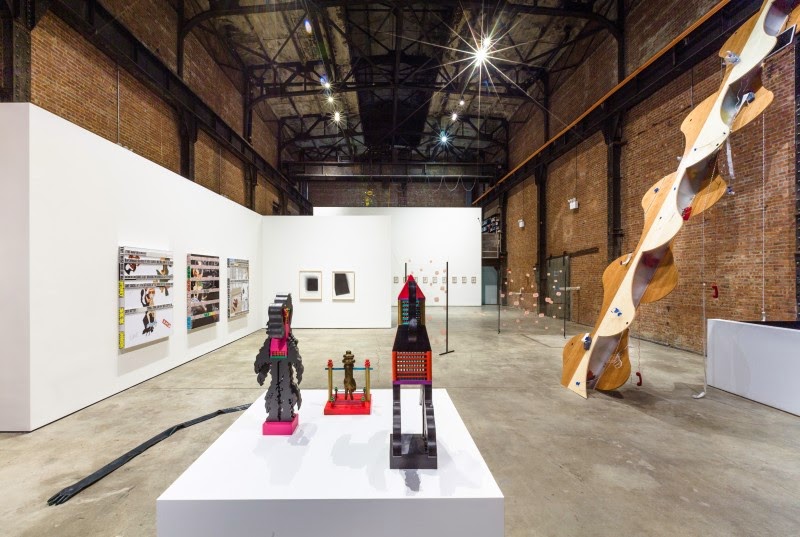
And today we have weights shining behind tempura-fried flowers and a press release stating that it’s “analyiz[ing] the acceptance of what it means to be human,” the acceptance seeming finally having stopped, given up, to smell roses, push up daisies, an exhibition called Death.

See too: "Flat Neighbors" at Rachel Uffner , Group Show at Bortolami

Wednesday, January 7, 2015

Koki Tanaka at Centre d’Art Contemporain Passerelle

CAP-Koki Tanaka 2014-031
(Koki Tanaka at Centre d’Art Contemporain Passerelle)

The terror of allegory is that humans placed under its banner immediately become symbols and their actions extrapolated as universal archetypes (slipping towards stereotypes) and denying the individual for false assumptions about the universal. This exhibitions subtitling itself as “a soundtrack for collective engagement” readies it as an inference, turning a documentary into a parable at the expense of the young adult’s being. The political intimation takes away from the chance of its operation, occluding the risk, and predetermining its allegory and extracting value from it a priori, almost as if the humans in its logic were secondary to it: It mattered little whether they succeeded or failed because the project itself was always bound to extract meaning from it.Demolishing what is the best part of documentaries in that genres liquidate their tropes and the relationship to narrative elements becomes estranged, at all moments one must reposition ourselves in relation to the characters, there is no deity to assuage a sensibility, coherence , or, worst, a moral. Like Restrepo, an antidote to all the Errol Morris style docs, the characters negate the spectrum of types to create a film whose bathos becomes its emotional impact. Far more moving than any of the eternal return fatalism of some recent Best Pictures.
The best part of this isn’t a idea about collectivity, but the base enjoyment of watching people, for which this video is phenomenal. People are generally more interesting than people’s ideas about them.

Tuesday, January 6, 2015

Stephen G. Rhodes at Vilma Gold

Stephen G. Rhodes at Vilma Gold
(Stephen G. Rhodes at Vilma Gold)

Paul McCarthy desublimation in Mike Kelley vernacular with Cameron Jamie theatricality of a John Bock or Mika Rottenberg abjection with Jonathan Meese irony, overlain with an overarching Jason Rhodes value production through storytelling (here in the droll PR) to make mess seem rational, making a fairly accurate depiction of culture, though none of it covers this exhibition's stoned Adult Swim aspect, again the absurd placed into the real. We differentiate art from the cultural forms it appropriates by the expectation of the artist’s self-reflexivity + self-consciousness and therein implicitly promising a “content” that culture doesn't. Yet whole swaths of art actively attends its jettisoning of this - or its absurdification - and the comedy it appropriates become more and more self-conscious, and the difference becomes that one is entertainment and the other is boring.

Monday, January 5, 2015

“The Contract” at Essex Street

"The Contract" at Essex Street
(“The Contract” at Essex Street)
Artists: Jay Chung and Q Takeki Maeda, Maria Eichhorn, Wade Guyton, Hans Haacke, Park McArthur, R. H. Quaytman, Cameron Rowland, Carissa Rodriguez

Haacke’s overt literalism was due to its merely exposing what was read between lines, its belief in the act of transparency. Oddly everyone in this exhibition - which takes its title in reference to Haacke - makes work that is overtly opaque, obfuscating and mysteriorizing itself in the opacity of its use of cultural symbols. If Haacke’s work was about transparency in the value extracted from art objects, the rest of the work in the show is about contemporary art’s extraction of value/content from culture, complicit in its own theft of value, “borrowing” symbols that were never lent. While appropriation foregrounds its act of theft, this exhibition’s implicit form is a possibly insidious version that guises itself as a form of critical doubling. Quaytman’s “borrowing” of Andrea Fraser’s most vertiginous performance, reprinting it under her own brand image - even if old orchard friends - placing even what has become her logo over the top of the image, what is this but a strange form of theft among friends? Is this exhibition an homage to "Haacke’s" seminal contract, which attempting through transparency to ink slight power to artist’s, or a simple vampiring of cultural capital of it, placing artists, literally, around it as if osmotically credibility it would absorb.
"Haacke’s" poster, contract, and idea was free; I can’t imagine anything else in this show is.

Saturday, January 3, 2015

“Dai Hanzhi: 5000 Artists” at Witte de With

Exhibition view 
Photo: Cassander Eeftinck Schattenkerk 

Installation photo, Witte de With Center for Contemporary Art, 2014
(“Dai Hanzhi: 5000 Artists” at Witte de With)

The death of Contemporary Art Daily will be another site with better formatting. The speed of consumption was what birthed CAD - the instant glut of it - yet it now lags with the machinations of its web1.0 formatting still using clickable arrows in aggressive pageview extraction tech. Group shows become a chore, clicking buttons like a neanderthal. If someone rehosted the exhibition images to be located on a single page it would kill CAD overnight. Like a Myspace waiting for a Facebook. Incredible that museums still give CAD  domain over their documentation. Their current position as the contemporary art world’s documentation curator is waiting to be usurped by those who plot it. Which, who currently is plotting this coup of the power it wields is ominous, for those who desire this power obviously have use to manipulate it.

Also this exhibition's celebration of the white guy among a group of chinese artists feels a little like a samurai film starring Tom Cruise.

Note: CAD is currently in the process of updating the format of the site.

Friday, January 2, 2015

“Puddle, pothole, portal” at Sculpture Center

"Puddle, pothole, portal" at Sculpture Center
(“Puddle, pothole, portal” at Sculpture Center)

Animation and Cartooning's comedy was premised on slapstick’s violence upon the real, stretching the real into a comic absurdity, teasing a threat to break it, which rationalizing this discrepancy forced laughter in children. Irrupting cartoons (or rotating ASCII) into the real - the real that we daily refer to as dissolving, mocked as “meatspace”- feels apt, funny, impish pranks of mischievous adolescent arts. What may be interesting about this show is that we have defined the moment, the kids grown on cartoons have arrived and their childhoods have coincidentally, absurdly, become the accurate depictions of the way the world has begun to feel, and will soon become generic, but at least we'll get to stop repeating ourselves.


See too: Danny McDonald at House of Gaga , Pentti Monkkonen at High Art , Nicholas Buffon at Freddy ,  Mathis Altmann at Freedman Fitzpatrick

Thursday, January 1, 2015

Jonas Wood at David Kordansky

Jonas Wood at David Kordansky
(Jonas Wood at David Kordansky)

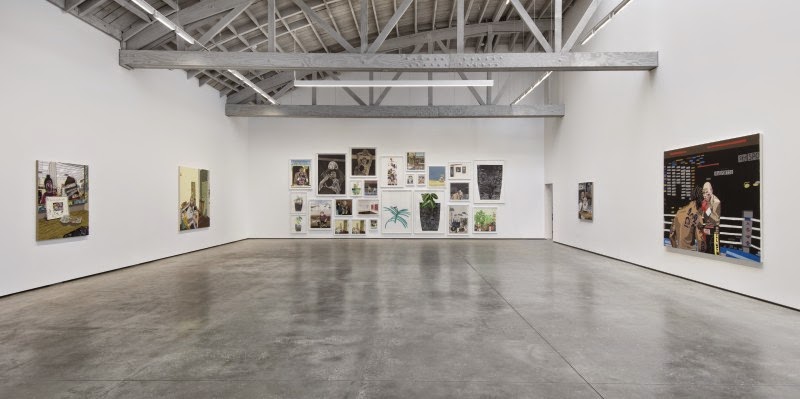
With the dilute abstraction of today’s forever now atemporal soup, the reptilian pleasure of seeing objects painted feels like relief. To see something rather than sift histories. Like 8bit nostalgia, or Guston’s plodding brushwork, the faux-niavete of Wood’s style magnifies choices made in representation, the shortcuts and decisions. The chunking holds the object depicted behind the filter of its maker, Wood’s subjectivity of calculating how to represent, the decisions sedimented as strokes itself a subject. The way a boxer's tattoos get rendered, or the way the likely commissioned portraits become suddenly less wonky. It’s an act of framing, holding “painting” at slight remove, like the pots as paintings, framing the container.  It’s stupid fun.