Tuesday, June 30, 2015

Nicola Tyson at Nathalie Obadia

Nicola Tyson at Nathalie Obadia
(link)

Calling something arbitrary abstraction is stupid so don't.  Abstraction itself is, and the rationalization of it breeds generic monsters and graduate theses.  Instead swing hard blindly. Tyson's paintings are wildly hit and miss, swinging so hard that a whiff is ugly overpowering, but a good one can really be something. I don't want to sound like a formalist here, but its really that teal that just smells so strongly of DIY bathroom decor, but that red is so sexy and those fingers like latex hotdogs.

Monday, June 29, 2015

Linder at dépendance

Linder at de?pendance
(link)

Aside from Linder's more explicit deconstructions of advertorial gaze, its basic formal tool of blasting an object onto another, virtual imposition, like Orozco's cat tins on watermelons, a sort of conceptual slapstick in the mistreatment of subject, a surrealism so primitive its feels like powerful comedy.

Sunday, June 28, 2015

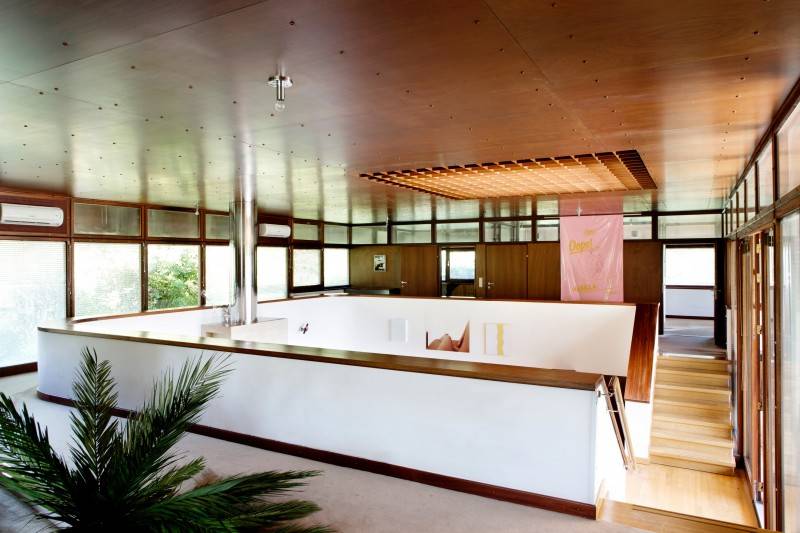
“New Needs” at Haus Wittmann

"New Needs" at Haus Wittman
(link)

Another Sunday on CAD. Address, keystroke, and scroll with hopes suspended over the small void before true boredom. Stop-gap info-fill. Click. Click. Horror vacuii a widespread contemporary affliction, replaced and transferred, and what's going on in the contemporary art world has pages refreshed with dopamine gambles. Imagine gunshots. Click. Roulette's small rush hoping for red interest, exciting, opening an exhibition to spend time, to see our name, transactions, dice rolled against real time ticker on the field of cultural production. Imagine violence. So play it cool. The gentility of another polite art kindly acquiescing to an architecture pleasant. Decorum so thorough its Austrian. Imagine Michael Haneke directing someone to suffocate his love with a pillow. Another Sunday group show on CAD, a beautiful day pouring in through Austrian architecture and webpages.


Saturday, June 27, 2015

Marte Eknæs, Sean Raspet at Room East

Marte Eknæs, Sean Raspet at Room East
(link)

Fincher turned the Calculation of Negligence into nihilistic mantra for millions of angst ridden boys, finding solace for their jade in a new schizo-sado-masculinity, solace in a brutality ending in terrorist fantasies of high-rises burning. It felt like relief. The main character's lavish condo exploding from a gas leak was ostensibly the best thing that ever happened to him. The non-accident we later learn is a symptom stemming from the very repressive bourgeois lifestyle it destroys. That the terrorist act was itself an expression of late-capitalist detachment, the same thing that Baudrillard would later claim in his "The Spirit of Terrorism" that capitalism expressed a sort of auto-terrorism, boredom itself bringing the towers down. The Pop success of both at least clarifies the latent cultural desire we have for the fantasy of watching the world burn so long as they are sublimated (make us able to believe we would never actually desire to see them enacted) through the filters of acceptable and neutering forms, pop-film or philosophy, and here art.

Anyway Eknaes and Raspet set the gallery on pins and needles, priming it for any disaster always unknown, anything because everything looks pretty spooky.

But we desire it.


See too: Sean Raspet at Société and Sean Raspet at Jessica Silverman

Friday, June 26, 2015

Andrea Fraser at Museum der Moderne

Andrea Fraser at Museum der Moderne
(link)

Fraser's kingdom to the firmly theorized ground of Institutional Critique is a problem. Though deservedly royalty of this particular genre, her bannership of - what has always appeared to be a very philosophically neat game - is the whitewashing of her messy, and messed, relationship to it. Fraser hasn't really been a good catholic in the halls of theory, despite her endless use of it. For all the calculated and brilliant and clear work and writing the artist has done, the more irreducible and psychological aspects of her practice is often left off in service to a sort of tidy moralizing theory that has become IC's legacy and leaving off the weird latent part of Fraser's wager of oneself as an institution and reflect, and this hall of mirrors has always left Fraser in tears, or naked.  The coldness of the tears isn't so much a gaming of representation performed, but hysteric postion from a dumb expected of course come true, a real catch-22 resultant attempts to reconcile competing desires incompatible. "Why Does Fred Sandback's Work Make Me Cry?" almost explicitly iterates this dissonance with two competing halves, an essay great because the tension between the two aren't reconciled, and leaves a giant gaping hole for IC's neat exterior, and contains no tidy moralizing, however moral a character. Fraser's work is more like a mental tentacle distributing its distress.

Thursday, June 25, 2015

Michaël Borremans at Dallas Museum of Art

Michaël Borremans at Dallas Museum of Art
(link)

Here the flesh returns to painting as Borremans' waxy version attempting to reestablish a corporeality that Tuymans, Richter, Sasnal paints our distance from. Borremans reconnects the body to its threat. Like early scenes in horror films - prior first blood - Borremans' forebode body-violence by situating it it within disorientating relations, establishing it as flesh. The body is imparted the possibility of being threatened. Borremans' realism exists to position the body capable of bodily "abstraction," (violence) the subtle wavering of flesh constructed by painter using brushstrokes to threaten hurt. Like Guston's plodding version establishing the act of drawing a painting, a Borremans painting loosens (abstracts) to threaten the body what could be done, coming apart with the fragile blow of a stroke. If the trope of horror-films was to die after sex, it was because the carnality established the body as fragile, human, meat; sex filled the character with blood for the destruction to come. I don't watch a lot of horror, but my guess is that there is another equal trope of putting body through some kind of medical examination, or equal expose, a moment to rub lotion into its skin, soften them. Borremans paintings are like that, trying to regain ground lost by those Germans who would coldly render it by giving its corpse (painting and body) back its blood.
Borremans treads dangerously close to the Gottfried Helnwein, a disserving though important relation, it exists as what Borremans is not but could be, treads close to, kitsch-horror. Making Borremans relation with an uncomfortable line plainly silly by having the line already crossed and staked and surveyed by an artist with all the bright lights showing, Hollywood actors writing favorable copy. It's unfortunate for Borremans having the third act of the horror show already known.

And see too: Luc Tuymans at David Zwirner, Andro Wekua at Sprüth Magers, Thomas Eggerer at Richard TellesKaoru Arima at Misako Rosen

Wednesday, June 24, 2015

Emanuel Rossetti at Karma International

Emanuel Rossetti at Karma International
(link)

The occult practices of another pagan-materialist presenting our experience as ritual, estranging us in an entertaining moment of alterity, bizarro-real, in which in moral hopes we must realign ourselves to its products, our experience of it, recognition delayed, and the static charge of our disorientation in finding an identification to hold onto, objects which connote but don't mean.  This type of work has been formalized, and this exhibition looks great, I respond positively to its aesthetic.

An interesting difference, with Trisha Donnelly there is nothing there, her objects are stubbornly dumb, unreciprocal, and a believer in Donnelly attempting conviction of any aesthetic "magic" has nothing, forced to "believe." With this Rossetti there is gesture and form and feng shui to talk about, just a difference.