
Friday, November 7, 2014

Thursday, November 6, 2014

For Bourdieu, Flynt was an example having committed the artworld’s “one unforgivable transgression” for “refusing to play the game, to challenge in accordance with the rules, i.e. artistically, their authors call into question not a way of playing the game, but the game itself and the belief which supports it. “
A 1964 issue of the village voice reports on Flynt, among others, protesting a Stockhausen performance passing out a “stylishly designed” leaflet warning that:
Aristocratic European Art has had a monstrous success in forcing veneration of itself on all the world, especially in the imperialist period. Everywhere that Bach, Beethoven, Bruckner, and Stockhausen are huckstered as 'Music of the Masters," white aristocratic European supremacy has triumphed. Its greatest success is in North America, whose rulers take the Art of West Europe's rulers as their own.And in Flynt’s own words that Stockhausen "received patronage from the ruling classes, [...] a lackey of the aristocrats." Though he would have preferred to picket Leonard Bernstein.
Flynt was, obviously, ahead of his time.
A time when he was mainly a musician - and in opposition to the general consensus of those sharing his marxist ideals - urged a return to “unpretentious” musical styles. Styles popular among the subaltern classes as an expression of solidarity with them, releasing albums spanning from aleatory to “hillbilly blues” with subtle Indian influences, and writing numerous philosophical treatises, before returning to the Artworld in the 80’s with a less radical more marketable gallery-ideas continually seeming on the cusp of breakthrough, though never getting it.
And so, now showing his absurdist fortune-cookies whose opaque comedy-drama is well described by the PR: ‘aim at something pithy but miss. (They are cracked.)” “elicit images synesthetically” “a derailed headspace [...] offered as an esthetic experience.” Operating by negating for a moment a logical thought, like placing a brick wall in your head. If only Flynt would continue with his populist ideals, give up the aristocracy of art, express a solidarity with the people and open a twitter account.
Wednesday, November 5, 2014
Andro Wekua at Sprüth Magers

As other artists predict the digital euphemizing of the body, Wekua’s re-tensions corporeality, hanging by threads of Narcissus's new glass pond. It’s both a romanticization of the body’s haptic analog in space - space that Wekua is so good at making uneasy - and, in young women’s endangerment, a slasher-flick mockery of it, the body.
Wekua re-updating the same threatening social moralism of horror movies and fairy tales, though the girl in the other room now riding triumphant over what originally made her a meal.
The spooky-ghost paintings are bad, acting as installation markers, nowhere near as stellar as Cathy Wilkes iron-dense versions.
See too : Cathy Wilkes at Tramway
Tuesday, November 4, 2014
Jana Euler at Kunsthalle Zürich

(link)
Unlike Kelm, or Cerletty whose expanding clue-board subjects serve towards conceptual opacity, Euler’s divergent subject maze, as the Press Release and Isabelle Graw’s breathless writing on the artist attest, is premised on the allure of its referential breadcrumbs baiting the viewer/reviewer down long winding paths of explication. We do not enter pictorial space so much as unpack its surface display. Self-awareness in symbiosis to the organs-without-body of art consecration - subtly highlighted in Graw’s admission to her own place within Euler’s network - is clever, smart. But that though the game is sometimes fun, often the explication is berating.
See too: Annette Kelm at Gio Marconi, Matthew Cerletty at Office Baroque.
Monday, November 3, 2014
Daniel Dewar and Grégory Gicquel at Micheline Szwajcer
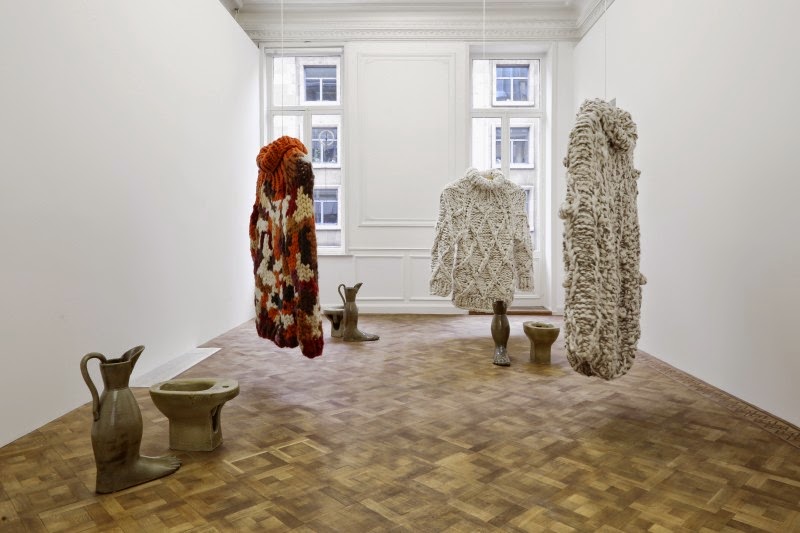
Pottery Barn and Eddie Bauer catalogs function in their emotive repackaging of idyllic mythos into the objects it sells, the same packaging of Boutoux’s PR here, imbuing wool thick with nostalgic ideals of romantic farm visions, warmth’s magic armor against the coldness of capital. Describing this doubling-nostalgia as Amanda Ross-Ho in a Pottery Barn suit would fail to acknowledge Robert Gober’s influence on all three and the remaking itself an affective trope. But whereas Ross-Ho’s scaling produces a sort of hippie signage as terror, or Gober’s cat litter as a story unto itself, the sweaters, toilet basins, and foot-jugs never best the nostalgia of craft that suffuses it.
Pottery Barn and Eddie Bauer catalogs function in their emotive repackaging of idyllic mythos into the objects it sells, the same packaging of Boutoux’s PR here, imbuing wool thick with nostalgic ideals of romantic farm visions, warmth’s magic armor against the coldness of capital. Describing this doubling-nostalgia as Amanda Ross-Ho in a Pottery Barn suit would fail to acknowledge Robert Gober’s influence on all three and the remaking itself an affective trope. But whereas Ross-Ho’s scaling produces a sort of hippie signage as terror, or Gober’s cat litter as a story unto itself, the sweaters, toilet basins, and foot-jugs never best the nostalgia of craft that suffuses it.
Sunday, November 2, 2014
Goshka Macuga at Rüdiger Schöttle

The hipster too was a semionaut; whose careful balance of fashion’s signs were an additive and appropriative construction of appearance and identity, a careful facade of references, and so the concurrent rise of Rachel Harrison makes symptomatic sense for its ability to thematize semio-collapse short-circuits in a way that was jokey, pranksterish and light relief against undeconstructable-tuber confusion of “the real” having really ascended into code that both Harrison and Hipsters were obviously responding. But artists now live it, take for granted the serial construction of references fashioning artistic identity whose appropriations need make little sense, that juxtaposition is enough capable of producing all the double-binds, oxymorons, and paradoxes that the artworld prefers in a the-more-the-merrier type campaign, creating perfect mires filled with loads of interpretive juice whose glossy surface reflected the world well.
The hipster too was a semionaut; whose careful balance of fashion’s signs were an additive and appropriative construction of appearance and identity, a careful facade of references, and so the concurrent rise of Rachel Harrison makes symptomatic sense for its ability to thematize semio-collapse short-circuits in a way that was jokey, pranksterish and light relief against undeconstructable-tuber confusion of “the real” having really ascended into code that both Harrison and Hipsters were obviously responding. But artists now live it, take for granted the serial construction of references fashioning artistic identity whose appropriations need make little sense, that juxtaposition is enough capable of producing all the double-binds, oxymorons, and paradoxes that the artworld prefers in a the-more-the-merrier type campaign, creating perfect mires filled with loads of interpretive juice whose glossy surface reflected the world well.
Saturday, November 1, 2014
Dan Graham at Greene Naftali

The banal-sinister that Graham early perfected still looking fresh despite its omni-influence over several generations as market diverse as Liam Gillick to Sam Pulitzer. A proto "relational" project whose difference was Graham’s work belied the corporate-style insidiousness of its MET rooftop friendliness, that Graham has always been, if not indifferent, at least analytically impersonal towards his subject matter, texts elucidating all the problems of its fun, punk, of the videos so comfortably viewed here, instead of letting its proponents speak for it, giving texts like “Punk as Propaganda” or “Rock my Religion” becoming a trope in its own right, in which opaque installations promote the texts that come with it.
The strangest of the whole thing is how similar Greene Naftali newly all in glass has begun to look like the corporate-pastiche of the art it houses.
Subscribe to:
Posts (Atom)