Sunday, November 16, 2014

“Fin de Siècle” at Swiss Institute

Fin de Siècle at Swiss Institute

Sometimes it's nice to just look at some chairs. The theatrical staging neuters the aura of their historical import, instead placed in a stage as characters among themselves. A Studio 54 crime scene whose acerbic mocking of cultural fashions erodes solemnity, able to see them as objects again, mostly as the awkward objects they are. Sometimes it's nice to just look at some chairs.

Friday, November 14, 2014

Amanda Ross-Ho at The Approach

Amanda Ross-Ho at The Approach
(link)

Scale doesn't render well in reproduction, and the shifting relations of scale to the viewer seem mostly lost. The bobby pins and scalpels further enlarged than the white wine, against un-enlarged umbrellas; discordant scales for an unnerving sound.

The “crime scene” - as the PR describes the exhibition - filled with clues as symbols, objects rendered as signs, impressing a (crtl+T) click-and-drag virtuality to the space they inhabit. They become inhuman in their enlargement, no longer calibrated to bodily comfort but instead a fun-house manicism, of the world made slapstick, the clowning gotten carried away to mocking humanism and expressing willful laughter over its needs, forcing themselves upon you by bludgeoning distance with the brute force of size. This glove at distance looks the size of the one on on your hand. The shifts in scale reassert their indifference towards yours. Unlike Mark Manders whose subtle percentage scale shifts produce an uncanny uncertainty, Ross-Ho’s objects have totally left the human world, expressing none of the sentimentality of Gober, but rather a cold aggressive plasticity of its information.
Like the masks central to this exhibition, human emotion is traded for its systematic expression, reduced to sundial rythmn’s clockwork, the phases of the moon, inhuman.

See too: Daniel Dewar and Grégory Gicquel at Micheline Szwajcer 

Thursday, November 13, 2014

Ida Ekblad at Herald St.

Installation View (Herald St.)
Courtesy: Herald St, London.

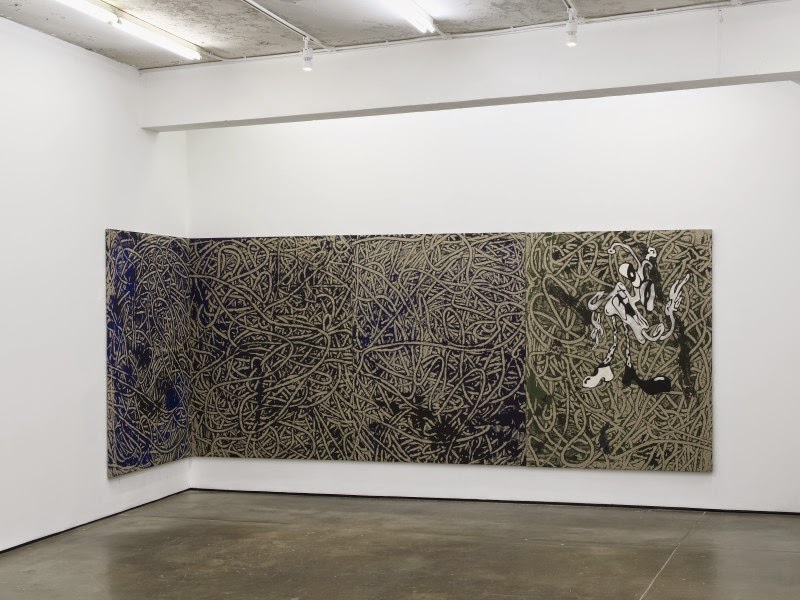
Having just mentioned painters hands lost in the turning of printing presses painting, here Ekblad arrives making what appear as, though cannot be certified by bombastic press release’s purple prose, monoprint paintings.

Like spaghetti fallen out of pockets in embarrassment - What was once the artist’s distinct color-forms clearly delineated and arranged, what was composed, has been melted into a miasma of stringy faux-naive fuck-all mess, of neophyte graffiti dusting, of everything crumbling. Previous work’s rational ordered pleasure traded for the irrationality of the abject, anal expulsive, as orders fail and worms grow into the corpse and a dried-scab cartoon characters appear to mock your desire for some return to good taste. Their illogic is a horror. Of course half the fun is learning to love it, this next step of gross painting.
Like Josh Smith it was the brash confidence of signatory strokes that held together their flimsy palmed aesthetic. Now the brash confidence of just showing these, currently standing heads above the others racing to re-abjectify abstraction, Smith, Eichwald, Buthe, Sittg etc. etc.

See too: Zak Prekop at Shane Campbell , Aaron Curry at Michael Werner

Wednesday, November 12, 2014

José Rojas at Vilma Gold

José Rojas at Vilma Gold


See too: "Flat Neighbors" at Rachel Uffner

Tuesday, November 11, 2014

Zak Prekop at Shane Campbell

Zak Prekop at Shane Campbell
(link)

The preponderance of overly tasteful paintings today is, in one sense, critically justified through its “reexamination” of modernism, particularly looking towards the forgotten’s more decorative tendencies, Delauney, Munch, Jawlensky, Hantai. And, coming out the mid-late 2000’s “indexicality” boom, in which every brushstroke was quotation and the artist’s hands removed for the theft - lost in the revolution of printmaking as painting - painting today still carries viewers' heads echoing this skepticism, and thus benefits: what was once derivative and gentle is now critical. It helps if you can carry this baggage out of your school.
The most interesting thing about Prekop’s paintings is the desire for the return of his hands, while looking not. The paintings do offer a little more in person, a use of transparency of linen, puzzles of layers, etc. In reproduction the visual unfolding of it’s making - the steps of what might-be but don’t-look-like a screenprint - are lost, the cleverness gone and the predominance of its nice-design packages is all one is left with, just how unbelievably tasteful these paintings today are.

Monday, November 10, 2014

Single Moms at Vilma Gold

Single Moms at Vilma Gold

According to the statement issued, the origin story was: Single Moms feeling, if not “disabled,” at least having “problems getting by” and so with a few phone calls got the band together making “plans to produce and possibly trade certain self manufactured commodities.” Set against stories of princes who choose to live as paupers, it takes on a altruistic hint of mission from god to raise enough money to save their orphan souls from eviction.
Interesting because it premises everything that came before as not commodities, that these new works under the group’s name were “beautiful home goods,” whereas whatever came before, under their individual selves, were neither. These plucky entrepreneurs, saw opportunity by entering, only now, into free markets as freeing them, meaning their not-commodity-objects could continue being so because these were for sale instead. That they weren’t selling out. Or, that they were selling out so as not to have to sell out.
An interesting trick to free yourself from the demands of cultural production for those of market production, reminiscent of S.O.A.P.Y.’s magick trick. Though an interestingly impossible distinction between luxury goods and art.  See too, Ooga Booga and Paradise Garage's Sweatshop among countless others.
Interesting because they look less like “beautiful home goods” and more like piles of contemporary art tropes. Interestingly even less so than the worded lamps, singing paintings, among other objects for which these artists are known. Interestingly being shown in a gallery setting. Interesting because like so much art today attaching little doodads to retail display systems it is hard to distinguish between desire for commodity and the desire for art.

See too : “S.O.A.P.Y. III” at What Pipeline

Saturday, November 8, 2014

Timur Si-Qin at Carl Kostyál


Timur Si-Qin at Carl Kostyál
(link)

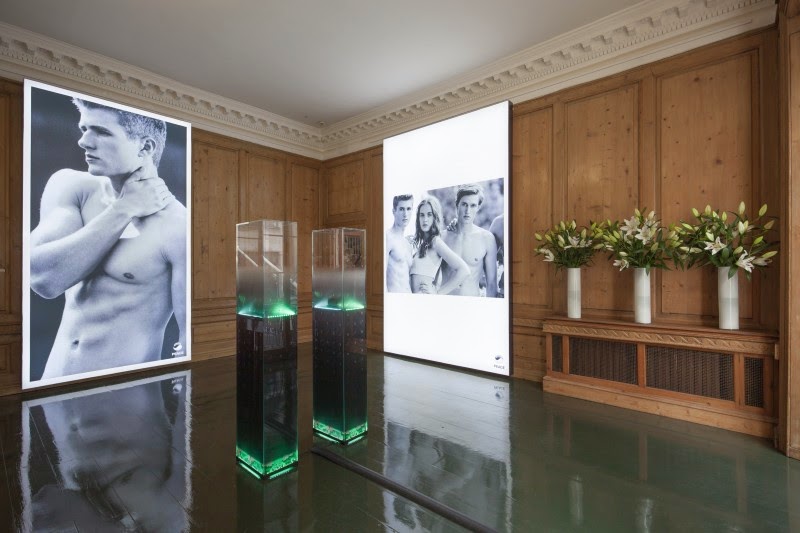
The new techno-conceptual. A Bernadette parasitizing of corporate campaigns, here in Abercrombie rather than Levi’s brands. Throwing in the tropes of today's high-tech trade show’s baroque eye-candy, they of course look great, they were made to.
Acting out a mis-en-scene installation displaying the display systems themselves, it presents today’s shopping experience as yesterday's pagan rituals, the work’s ostensible entomopathogenic function serves to force its host, the luxury goods system, to self-expose.
This is the Koonsian fantasy of the gallery, that objects put under its disenchanting light will perform a sort of auto-dissection. That the clean myth-body sex of its advertorial objects act as critique rather than a mere transference of its subject’s fetish to the work itself, acting as pagan materialist totems, like shooting bullets through medieval armor. As the PR states the exhibition is the “the mindless mirror,” that though literal and obvious - like the real use of such means - overt hamfistedness never lessens the affect, however stupid, like the hominidae skulls they contain, on the cusp of becoming something human.


See too: Ben Schumacher at Musee d’art contemporain de Lyon, Simon Denny at Portikus, Pamela Rosenkranz at Karma International