Showing posts with label MoMA PS1. Show all posts

Monday, September 18, 2017

Ian Cheng at MoMA PS1


(link)

A video game you can't play, a narrative irresolute: a scaffold to hang a flag waving new digital technologies. The flag waves complexly in the breeze, and we admire it. Of perhaps more interest than the flag itself is the simple parameters that generate such complexity, gas, a flexible surface; a problem for both meteorology as well as animation, one predictive and one representational. The elegance of schooling fish can be modeled with simple rules, stay close but not too close, and voila without leader or choreography, a coordination, a process called emergence. If there is to be interest here in storyless narratives, it is in determining the logic governing Cheng's boy and his dog, the subjectivity behind it, like any artwork or people's behavior, the rules behind the object. “We have no need of other worlds. We need mirrors." and in the metaphorical mirrors the rules governing Cheng's programming resembling us more interesting.


Sunday, September 10, 2017

Maureen Gallace at MoMA PS1


(link)

Gallace's paintings, for all their summer breeze and panache, are cagey, closeted, revealing little about their ostensible subject, homes, perhaps nostalgia. The paintings filter through a haze despite their seemingly intense observation; the buildings bear the indistinctness of memories even if the light and setting do not. Whereas generally depictions of homes emphasize facade, surface details, Gallace is at pains to scrub the walls into blank surfaces, vague windows, emphasizing the box, accentuating volume, alluding to the space inside, the subjects we can't see. The house is a metaphor for painting: a container that reveals nothing about its interior, the subject; Gallace's only paintings of with interiors appear to also be self-portraits.


See too: Gina Folly at Ermes-Ermes

Wednesday, September 14, 2016

Vito Acconci at MoMA PS1


(link)

Twisting conceptual art's fascination with linguistic bureaucratics, Acconci made grotesque conceptual Art's fetish for rules as a nightmarish pedagogical authority, made to assert his body frighteningly close. No excuse unturned for Acconci to get close and expose his body, voice or marmot-like nutsack. And his use of conceptual authority to instruct bodies in some way exposed conceptual art's ability to neutralize certain of its more abusive aspects. Wasn't conceptual art's denial of pleasure subsumed into instruction and authority itself a fetish.

Monday, September 7, 2015

Simon Denny at MoMA PS1

Long Island City, NY Apr 3, 2015: Simon Denny: The Innovator's Dilemma photos by Pablo Enriquez for MoMA PS1
(link)

There's a great panel discussion published with Denny in which his staunch refusal to talk about artmaking in any terms but the corporate terms of "product" "content" and "brand" leaves the other art-types at a sort of incredulous distance, wondering whether to refute the position (corporate terms obviously implying evil) or understand it at the safe distance of metaphor. This "struggle" to come to terms with such description is mirrored in much of the writing about Denny's work, in which writers search desperately to find where the critique - that of course must be there- lay.

Throwing two cents into the pile of change one hopes to be in the world: there isn't "critique" in the ambivalence of Denny's semi-archaeological work, and if there is, it is a tangential critique of the art-world itself, that the Artworld is much less interesting than the oddness of "experience" larger-Culture provides, even its objects. That an exhibition of Mega founder's collection of - what one glossy art magazine felt it without qualifier could be stated as "bad art" - misses the reflexivity of such situation in which a representation of an artifact of culture, an exhibition of "bad art" would be a more interesting experience than more art itself. Whether Pierre Menard or the Quixote himself, "critique" for Denny would only be part of experience of the product, its brand. And, in the same panel, stating a complicitness with capitalism that he doesn't want to kill, Denny is challenged asked what he does "want to kill," again implying the assumption of "critique" that the artworld so desperately needs for its own ends to be there. Denny responds, "That's not my goal. My goal is to make interesting content."


See too: Simon Denny at Portikus, Timur Si-Qin at Carl KostyálBen Schumacher at Musee d’art contemporain de Lyon

Friday, September 5, 2014

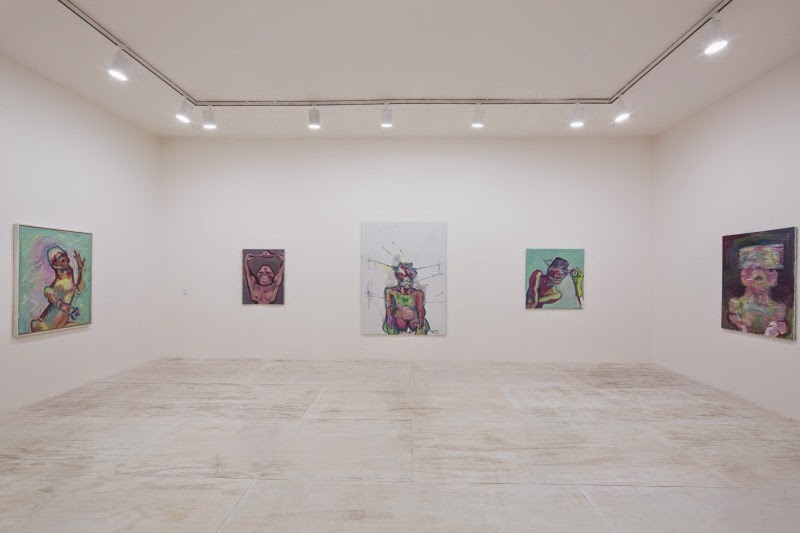
Maria Lassnig at MoMA PS1

Installation view of Maria Lassnig at MoMA PS1, 2014. © 2014 MoMA PS1; Photo Matthew Septimus.

It’s the ones that run near amok that are best, the ones that feel just outside the border of able-to-keep-your-ducks-in-a-row.  There's a distinct level of Voyeurism involved here.
Questions remain of who is/can-be delegated the task of subjective expressions. The question gets run-off into intentions, and choice, and knowability of the subject, and is this “behaving,” and but every artist today is a well behaved one, so possibly moot.
Lassnig’s subject-object problem permutes, prescient proto-version of Sillman’s bodies-that-matter imbued formalism, and many others, Lassnig even depicting a literalized morphosis of abstract-form-subject. Borges stating the writer invents their historical influences, and maybe its the wave now that makes visible Lassnig at all.  Strange how pleasing the abstractions are and how formally-subservient-to-what-they-depict the representational are.
What’s missing here is her words used to describe the work, totally out-of-line of today’s standards.